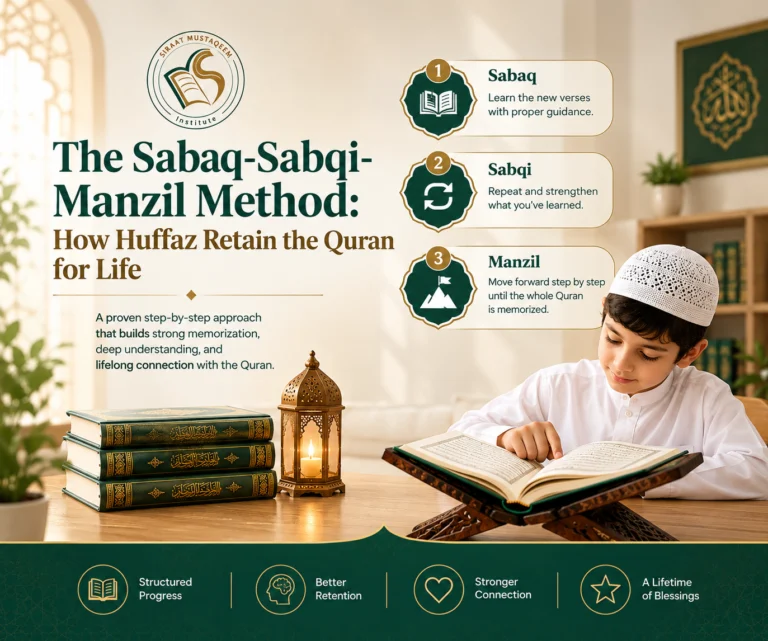
The Sabaq–Sabqi–Manzil Method: How Traditional Huffaz Retain the Quran for Life
Ask any hafiz who memorized the Quran decades ago how they still recall every ayah without hesitation, and you will almost always hear the same three words: sabaq, sabqi, and manzil. This three-part system is not a modern shortcut or a trendy app feature. It is the backbone of traditional Quran memorization, refined over centuries in madrasas and Quran schools across the Muslim world, from Al-Azhar in Egypt to the Darul Ulooms of South Asia.
Many students memorize the Quran once in their lives and lose most of it within a few years simply because they never revised it properly. The Sabaq-Sabqi-Manzil method exists precisely to prevent that. It treats memorization not as a one-time event, but as a lifelong relationship with the Quran, built on structured repetition, accountability, and daily discipline.
In this guide, we will break down exactly what each part of the method means, how a typical daily session is structured, why it works so effectively from a memory-science perspective, and how you can apply it whether you are a child in a hifz program, an adult learner, or a parent supervising your children at home.
What Does Sabaq-Sabqi-Manzil Mean?
The three terms come from Arabic and Urdu terminology used in traditional Islamic education, and each one represents a distinct stage of the memorization journey.
Sabaq (New Lesson)
Sabaq simply means “the new lesson.” This is the fresh portion of the Quran that a student memorizes for the first time on a given day, usually under the direct supervision of a Quran teacher or huffaz-e-Quran instructor. The teacher listens to the student recite the newly memorized lines, corrects mistakes in pronunciation and tajweed, and only approves the sabaq once it is recited flawlessly from memory.
Sabqi (Recent Revision)
Sabqi refers to the recent revision, meaning the portion memorized over the last several days or weeks that has not yet been fully consolidated into long-term memory. This is the most fragile stage of retention. A student typically revises the last five to seven days’ worth of sabaq every single day until it becomes stable enough to move into the manzil stage.
Manzil (Old Revision)
Manzil is the long-term revision cycle. Once a portion of the Quran has been thoroughly stabilized through sabqi, it graduates into the manzil, a rotating cycle in which the entire previously memorized Quran is revised in sections on a recurring schedule, often one juz (chapter unit) per day, so that the whole Quran is revisited roughly once a month or once every few weeks.
Together, these three stages form a continuous cycle: today’s sabaq becomes tomorrow’s sabqi, and eventually settles permanently into the manzil rotation.
A Typical Daily Sabaq-Sabqi-Manzil Schedule
While every teacher and institution adjusts the pace to the student’s ability, a common structure looks like this:
- Sabaq (new memorization): 1 page (or a set number of lines) memorized and recited to the teacher without mistakes.
- Sabqi (near revision): The last 5 to 10 pages memorized, revised daily until fully solidified.
- Manzil (far revision): A rotating portion of the Quran already memorized months or years earlier, revised so the entire hifz is completed roughly every 30 days.
A student who memorizes consistently using this method does not just “finish” the Quran once. They keep revisiting it for the rest of their life, which is exactly why lifelong huffaz can recite the entire Quran from memory even fifty years after they first completed it.
Why the Sabaq-Sabqi-Manzil Method Works
This traditional system aligns closely with what modern cognitive science calls spaced repetition. Information that is reviewed at increasing intervals moves from short-term to long-term memory far more effectively than information crammed once and never revisited.
- It prevents forgetting curves. Human memory naturally decays fastest right after learning something new. The daily sabqi revision catches that decay before it becomes permanent forgetting.
- It builds long-term neural pathways. By the time a portion reaches the manzil stage, it has been recited correctly dozens of times, making recall almost automatic.
- It creates accountability. Because a teacher listens to the sabaq, sabqi, and manzil daily, mistakes are caught early instead of becoming ingrained habits.
- It balances progress and retention. Students keep adding new memorization (sabaq) without sacrificing what they already memorized (sabqi and manzil), which is the single biggest reason huffaz forget the Quran when this balance is ignored.
Common Mistakes That Break the Method
- Skipping manzil to “save time” for new sabaq. This is the most common reason huffaz lose their memorization years later. New progress means nothing if old portions are not maintained.
- Increasing sabaq too quickly. Memorizing more pages per day than the sabqi revision can handle leads to shallow memorization that fades fast.
- Revising alone without a teacher. Self-revision without correction allows small tajweed and pronunciation errors to become permanent habits.
- Inconsistent daily practice. The method depends on daily repetition. Missing even a few days of sabqi can undo weeks of stabilization.
How Parents and Adult Learners Can Apply This Method
You do not need to be enrolled in a full-time hifz program to benefit from this structure. Here is how it adapts to different situations:
For children in a hifz program: Ensure homework time at home is dedicated to sabqi revision, not just preparing tomorrow’s new sabaq. Many students who fall behind do so because home practice focuses only on the new lesson.
For adult learners: Start with a smaller daily sabaq, even a few lines, and be strict about daily sabqi revision before adding a manzil rotation once you have a stable base of several juz.
For parents supervising memorization: Keep a simple revision log tracking which juz is due for manzil each day, and listen to your child recite it, even if you are not a native Arabic speaker; you can still catch hesitation and stumbling.
Working with a qualified teacher accelerates all of this considerably, since correct tajweed and structured pacing are difficult to self-assess. A guided Quran Memorization Course applies exactly this Sabaq-Sabqi-Manzil structure with a certified teacher tracking your daily sabaq, sabqi, and manzil so nothing slips through the cracks.
Frequently Asked Questions
What is the Sabaq-Sabqi-Manzil method? It is a traditional three-stage Quran memorization system consisting of sabaq (new memorization), sabqi (recent revision of the last several days), and manzil (long-term rotating revision of the entire previously memorized Quran).
How much Quran should I memorize per day using this method? There is no fixed universal amount; it depends on the learner’s age, pace, and available time. Many programs start with a few lines to one page per day, increasing only once sabqi revision remains fully stable at the current pace.
Why do huffaz forget the Quran even after completing hifz? The most common reason is neglecting the manzil (long-term revision) cycle after completing memorization. Without a rotating revision schedule, previously memorized portions gradually fade from memory, regardless of how well they were originally memorized.
How long does a full manzil cycle usually take? Many huffaz aim to complete a full manzil cycle, revising the entire memorized Quran, approximately once a month, often by revising one juz per day, though this pace can be adjusted based on the individual’s schedule and memorization volume.
Can adults use the Sabaq-Sabqi-Manzil method, or is it only for children? The method works for learners of any age. Adults can apply the same three-stage structure, adjusting the daily sabaq pace to fit their schedule while keeping sabqi and manzil revision consistent.
Do I need a teacher to follow this method effectively? While self-study is possible, a qualified teacher is highly recommended because they can correct tajweed and pronunciation errors during sabaq, sabqi, and manzil sessions before those mistakes become permanent habits.
Final Thoughts
The Sabaq-Sabqi-Manzil method endures because it treats Quran memorization honestly: as something that must be maintained, not just achieved. New memorization without daily revision fades. Revision without new progress stalls. It is the balance between all three, sabaq, sabqi, and manzil, sustained day after day, that produces huffaz who can recite the entire Quran flawlessly decades later.
If you want to build this habit correctly from the very first day, structured guidance makes a lasting difference. Our Quran Memorization Course is built around this exact Sabaq-Sabqi-Manzil framework, with a certified teacher tracking your daily new lesson, recent revision, and long-term revision cycle so your memorization stays with you for life.