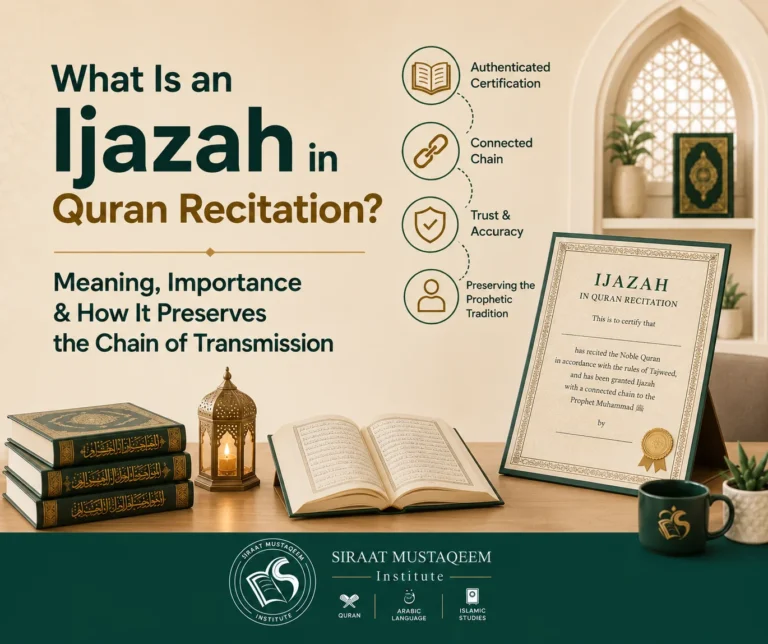
What Is an Ijazah in Quran Recitation?
If you have spent any real time around Quran teachers, you have probably heard the word “Ijazah” mentioned with a certain reverence. It is not a certificate you print off after watching a few videos, and it is not a participation badge for finishing a course. An Ijazah is a license — a formal, chain-linked permission to recite and teach the Quran exactly as it has been passed down, mouth to ear, for over 1,400 years.
For many students, the word itself feels a bit mysterious. What does it actually certify? Who can give one? And is it something an average Muslim can realistically pursue, or is it reserved for scholars in Al-Azhar lecture halls? This guide answers all of that in plain language, then walks through the practical side — how the process works, what it takes, and how you can begin working toward it, even from home.
What Does “Ijaza” Mean in Arabic?
The word Ijazah (إجازة) comes from the Arabic root meaning “to permit” or “to authorize.” In everyday Arabic, the same root shows up in words related to permission and leave — an Ijazah is literally a “permission” or “license.”
In the context of the Quran, an Ijazah is a formal certification given by a qualified teacher (often called a Sheikh or Sheikha) to a student, confirming that the student has:
- Memorized and/or recited the Quran accurately, according to the rules of Tajweed
- Mastered a specific recitation (Qira’ah) or reading style
- Recited the entire Quran directly to the teacher, verse by verse, without significant errors
- Earned the right to transmit that same recitation to others with the teacher’s authorization
This is very different from a school diploma. An Ijazah isn’t awarded for attendance or coursework alone — it’s awarded because the teacher personally listened to the student recite and is vouching, with their own name and reputation, that the student recites correctly.
What Is Ijazah in Quran Recitation, Exactly?
An Ijazah in Quran recitation is a certified chain of authorization (sanad) that connects a student, through their teacher, all the way back through a continuous line of scholars to the Prophet Muhammad (peace be upon him), who received the Quran directly from the Angel Jibreel (Gabriel).
This chain is the heart of what makes an Ijazah meaningful. Anyone can read the Quran from a printed copy, but the Ijazah system exists to preserve something a printed page cannot capture on its own: the exact oral sound of the Quran — the precise pronunciation, pauses, elongations, and articulation points of every letter — transmitted person to person, generation after generation.
When a student receives an Ijazah, they are not just told “well done.” They receive a sanad (a documented chain of narrators) that lists every teacher in that unbroken line, and the certificate itself typically states:
- The student’s full name
- The specific reading (Qira’ah) or portion of the Quran covered
- The name of the certifying teacher and their own chain of authorization
- The date and location of certification
- Sometimes a signature or seal from the teacher or institution
This is why an Ijazah is often described as one of the oldest, most rigorously preserved forms of academic certification in the world — older than the university system itself.
Why Does the Ijazah System Exist?
The short answer: to protect the Quran from drift in pronunciation over time.
Language changes. Accents shift. Without a living, verified chain of transmission, small errors in recitation could accumulate over generations and eventually change the sound — and in some cases, the meaning — of the words. Since Muslims believe the Quran is the literal, unaltered word of Allah, this was never something the early scholars were willing to risk.
So instead of relying only on written manuscripts, they built a parallel system of oral transmission, where every reciter had to prove their recitation was verified by someone who had, in turn, been verified by someone before them — a human chain of quality control stretching back to the Prophet ﷺ himself. That system is the Ijazah, and it is still active and functioning exactly the same way today.
How Hard Is It to Get an Ijazah?
This is one of the most common questions students ask, and the honest answer is: it depends on the scope of the Ijazah, but it is genuinely demanding.
An Ijazah is not something rushed. It typically requires:
- Strong prior foundations — most teachers require a student to already read Arabic fluently and have completed a solid Tajweed course before starting Ijazah-level study.
- Full memorization or full recitation — depending on the type of Ijazah, the student must either memorize the entire Quran (Hifz) or be able to recite the entire Quran directly from the Mushaf with correct Tajweed, without significant mistakes.
- One-on-one verification — the student recites to the teacher, portion by portion, and the teacher corrects every mistake in real time. This isn’t a one-time test; it’s often months or years of ongoing correction.
- Consistency — a single good recitation session isn’t enough. Teachers want to see that accurate Tajweed has become the student’s default habit, not a performance.
- Understanding the rules, not just applying them — many teachers expect students to be able to explain why a rule applies (e.g., why a specific letter is elongated), not just recite correctly by memory.
So is it “hard”? Yes — a full Ijazah in Hafs ‘an ‘Asim (the most widely recited Qira’ah today) covering the whole Quran commonly takes anywhere from 1 to 3+ years of consistent, focused study, depending on the student’s starting level, prior memorization, and how many sessions per week they commit to. Partial Ijazahs (covering a portion of the Quran, or intended purely to certify Tajweed proficiency rather than a full Qira’ah) can be completed faster.
The difficulty is also exactly what gives the Ijazah its weight. It’s meant to be hard to obtain precisely because it’s a serious responsibility — someone holding it is now qualified to certify others.
How to Obtain an Ijazah: Step by Step
If you’re wondering how the process actually works in practice, here’s the realistic path most students follow:
Step 1: Build a solid Tajweed foundation. Before Ijazah study can even begin, a student needs to read Arabic script confidently and understand the core Tajweed rules — the makharij (articulation points), the rules of Noon Sakinah and Meem Sakinah, elongation (madd) rules, and more.
Step 2: Find a qualified, connected teacher. This is the most important step. The teacher must themselves hold a valid Ijazah with an authentic chain of transmission — otherwise, what they pass on to you won’t be a real Ijazah, just a certificate of completion. Look for teachers certified by recognized institutions (Al-Azhar is the most widely respected globally).
Step 3: Recite one-on-one, consistently. The student recites directly to the teacher — traditionally in person, though today this happens just as effectively through live, one-on-one online video sessions. The teacher listens closely and corrects errors immediately, portion by portion.
Step 4: Progress through the full Quran (or the agreed portion). Depending on the goal, this could mean the entire Quran or a defined juz’/surah selection. The teacher tracks progress and revisits weak areas.
Step 5: Final assessment and certification. Once the teacher is fully satisfied — not just that the student can recite correctly, but that they consistently do so — the Ijazah is granted, along with the sanad documenting the chain of narrators back to the Prophet ﷺ.
A common misconception is that an Ijazah can be obtained through self-study or by watching recitation videos. It cannot. The defining feature of an Ijazah is direct, verified, one-on-one transmission from a certified teacher — that human link is non-negotiable.
Types of Ijazah
Not every Ijazah covers the same thing. In practice, students commonly pursue one of these:
- Ijazah in Tajweed — certifies that the student recites the entire Quran with correct application of Tajweed rules (this is the most commonly pursued Ijazah among non-native Arabic speakers).
- Ijazah in Hifz (memorization) — certifies the student has memorized the entire Quran and can recite it from memory accurately.
- Ijazah in a specific Qira’ah — certifies mastery of one of the recognized canonical reading styles (see below).
- Ijazah with multiple chains (asanid) — advanced scholars sometimes hold Ijazahs through several different teachers and chains, strengthening the authenticity of their transmission.
What Are the 7 Types of Quran Recitations (Qira’at)?
This question comes up often alongside Ijazah, since some Ijazahs are tied to a specific Qira’ah. Islamic scholarship recognizes seven canonical Qira’at (recitation styles), each traced back through a specific chain of narrators to the Prophet ﷺ. They differ mainly in subtle points of pronunciation, vowel length, and occasionally word form — not in meaning or content. The seven are:
- Nafi’ al-Madani (narrated by Warsh and Qalun)
- Ibn Kathir al-Makki (narrated by Al-Bazzi and Qunbul)
- Abu ‘Amr al-Basri (narrated by Al-Duri and Al-Susi)
- Ibn ‘Amir al-Shami (narrated by Hisham and Ibn Dhakwan)
- ‘Asim al-Kufi (narrated by Hafs and Shu’bah) — Hafs ‘an ‘Asim is by far the most widely used recitation today across the Muslim world
- Hamzah al-Kufi (narrated by Khalaf and Khallad)
- Al-Kisa’i al-Kufi (narrated by Abu al-Harith and Al-Duri)
Most students today — especially outside the Arab world — pursue an Ijazah in Hafs ‘an ‘Asim, since it’s the recitation used in the vast majority of printed Mushafs and heard in mosques worldwide.
Can You Get an Ijazah Online?
Yes — and this is one of the more reassuring developments for students outside the Middle East. The Ijazah system depends on direct, verified, one-on-one recitation to a qualified teacher — it has never required physical presence in the same room. Live video classes now make this connection just as reliable as sitting across from a teacher in person, as long as the sessions are genuinely live, one-on-one, and led by a teacher who holds an authentic chain of transmission.
This is exactly the structure behind the Online Quran Ijazah Course at Siraat Mustaqeem. Students work one-on-one with Al-Azhar certified teachers, reciting live and receiving real-time correction, with a personalized study plan built around their current level — whether they’re just finishing Tajweed or already deep into memorization. Since the Ijazah journey typically follows a natural sequence, many students first complete the Tajweed Rules Course or the Quran Memorization Course before formally beginning Ijazah study.
If you’re not sure which stage you’re at, a free trial session with a teacher is the simplest way to find out — the teacher listens to your current recitation and maps out what’s actually needed to reach Ijazah level from where you stand today.
Is an Ijazah the Same as a Certificate of Completion?
No, and this distinction matters. A certificate of completion typically just confirms a student finished a course — attended the sessions, covered the material. An Ijazah is a personal, individual authorization from a specific teacher, tied to that teacher’s own chain of transmission, confirming the student’s recitation has been verified as accurate and can now be passed on to others. You cannot mass-produce Ijazahs the way you can print completion certificates — each one represents a real teacher personally vouching for a real student’s recitation.
Final Thoughts
An Ijazah is more than a credential — it’s a place in a living chain that connects a student’s voice, across 1,400 years, back to the Prophet Muhammad ﷺ himself. That’s what makes the process demanding, and it’s also what makes it worth pursuing. Whether your goal is to teach others one day, deepen your own connection to the Quran, or simply hold yourself to the highest standard of recitation, the path runs through the same steps: solid Tajweed, a qualified teacher, and consistent, verified practice.
If you’re ready to start that path — or just want an honest assessment of how far you have to go — book a free trial class with one of our Al-Azhar certified teachers and find out where to begin.
Frequently Asked Questions (FAQ)
What is Ijazah in Quran? An Ijazah in Quran is a formal license granted by a qualified teacher, confirming that a student has accurately recited (and often memorized) the Quran, and authorizing them to transmit that recitation to others through the same verified chain of teachers stretching back to the Prophet Muhammad ﷺ.
How hard is it to get an Ijazah? It’s genuinely challenging — a full Ijazah covering the entire Quran commonly takes 1 to 3+ years of consistent one-on-one study, depending on the student’s starting level and how many weekly sessions they commit to. Partial Ijazahs or Tajweed-focused Ijazahs can take less time.
How to obtain an Ijazah? By building a solid Tajweed foundation first, then reciting one-on-one and consistently to a qualified teacher who holds their own authentic chain of transmission, until the teacher is satisfied the recitation is accurate and consistent enough to certify.
What does ijaza mean in Arabic? “Ijaza” (إجازة) comes from an Arabic root meaning “permission” or “authorization” — literally, a license to do something, in this context, to recite and teach the Quran.
What are the 7 types of Quran recitations? The seven canonical Qira’at are: Nafi’ al-Madani, Ibn Kathir al-Makki, Abu ‘Amr al-Basri, Ibn ‘Amir al-Shami, ‘Asim al-Kufi (Hafs ‘an ‘Asim is the most widely used today), Hamzah al-Kufi, and Al-Kisa’i al-Kufi.
Can I get an Ijazah through online classes? Yes. As long as the classes are live, one-on-one, and taught by a certified teacher with a genuine chain of transmission, an online Ijazah carries the same validity as an in-person one.
Do I need to memorize the whole Quran to get an Ijazah? Not always. An Ijazah in Tajweed only requires accurate recitation of the entire Quran while reading from the Mushaf, without full memorization. An Ijazah in Hifz specifically certifies memorization. Many students pursue the Tajweed Ijazah first.