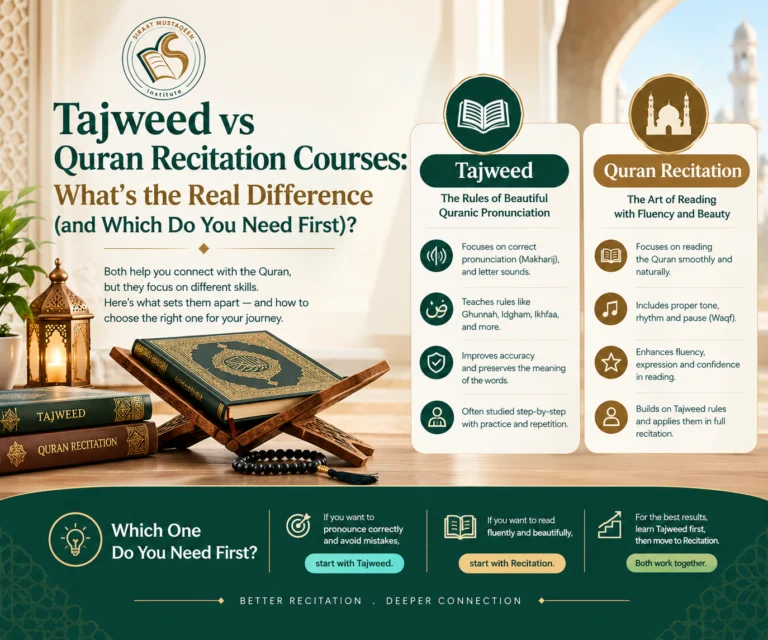
Tajweed vs Quran Recitation Courses : What’s the Real Difference (and Which Do You Need First)?
Quick Answer
If you’re short on time, here’s the one-paragraph version: Tajweed is the set of rules for how to pronounce Quranic letters and sounds correctly. Quran Recitation is the skill of applying those rules while actually reading, at a natural pace, with proper rhythm and flow. Tajweed is the “grammar book.” Recitation is “speaking the language.” Most students need to start with Tajweed, then move into Recitation to turn the rules into a habit rather than something they have to think about mid-verse.
That’s the short version. Now let’s break down why this distinction trips up so many students, what each course actually covers day to day, and how to know which one fits where you are right now.
Why This Question Comes Up So Often
Search “learn Quran online” and you’ll find dozens of course names that sound almost identical: Tajweed course, Quran recitation course, Quran with Tajweed course, Quran reading course. For a parent choosing lessons for a child, or an adult starting from scratch, it’s genuinely hard to tell whether these are three different things or the same thing marketed three different ways.
They’re related, but they’re not interchangeable. Getting the order wrong is one of the most common reasons students feel stuck — either bored repeating rules they already half-know, or frustrated trying to recite fluently without the rule foundation to make sense of their mistakes.
What Is Tajweed, Exactly?
Tajweed (تجويد) literally means “to make better” or “to improve.” In practice, it refers to the codified rules governing how each Arabic letter in the Quran should be pronounced — where the sound originates in the mouth or throat (makharij), how letters are lengthened (madd), when a nasal sound is applied (ghunnah), how letters merge or are exchanged next to one another (idghaam, ikhfa, iqlab), and dozens of other precise rules that have been preserved and transmitted for over 1,400 years.
A Tajweed course is essentially rule-focused. A typical lesson looks like: the tutor introduces a rule, demonstrates it with example words, has the student repeat isolated words or short phrases, and corrects pronunciation until the rule is applied correctly and consistently — often before moving through much actual Quran text at length.
If you want the fuller picture of what these rules cover and why they matter, our complete beginner’s guide to Tajweed walks through it from the ground up, and the online Tajweed course for kids and adults guide covers what a structured program looks like in practice.
What Is a Quran Recitation Course?
A Quran Recitation course assumes you already know (or are learning in parallel) the Tajweed rules, and shifts the focus to applying them while reading real verses, fluently, at a natural pace. This is where a student stops pausing to consciously recall “is this a madd of two counts or four?” and starts reciting the way a fluent reader does — where correct pronunciation has become automatic.
Recitation practice also brings in elements Tajweed drilling alone doesn’t emphasize as heavily:
- Fluency — reading longer passages without stumbling or losing your place
- Rhythm and melody (tarteel) — the measured, unhurried pace the Quran is meant to be read with
- Confidence — reading aloud smoothly instead of hesitating word by word
- Endurance — sustaining correct pronunciation across a full page or Surah, not just a single line
This is the practical, “put it all together” stage. You can learn more about how this stage is taught in Learn Quran Recitation Online with Tajweed.
Tajweed vs Recitation: Side-by-Side Comparison
| Tajweed Course | Quran Recitation Course | |
|---|---|---|
| Main focus | Learning individual pronunciation rules | Applying rules fluently across real verses |
| Pace of lessons | Slower, rule-by-rule, word-level practice | Faster, passage-level and Surah-level practice |
| Best for | Beginners, or anyone unsure why their pronunciation is off | Students who know the rules but need fluency and confidence |
| Typical outcome | Correct pronunciation, letter by letter | Smooth, natural, rule-compliant reading |
| Analogy | Learning grammar rules | Speaking the language fluently |
| Where it fits | Usually taken first | Usually taken after, or alongside, Tajweed |
So Which One Do You Need First?
For most people, the honest answer is: Tajweed first. Here’s why the order matters more than it might seem.
Recitation practice is really just Tajweed rules in motion. If a student hasn’t learned the rules yet, “recitation practice” ends up reinforcing whatever pronunciation habits they already have — correct or not — simply because there’s no rule framework to catch the mistake in the moment. This is one of the most common Quran memorization and recitation mistakes to avoid: building fluency on top of an error, which then becomes much harder to unlearn later.
That said, there are a few situations where the two are approached differently:
Start with Tajweed if:
- You’re a complete beginner or new Muslim just learning to read Arabic script and Quranic sounds
- You already read Quran but were never formally taught the rules (very common) and want to check for hidden mistakes
- You’re preparing your child for structured Quran learning after they’ve finished the Noorani Qaida foundation
Move into (or add) Recitation if:
- You’ve completed a Tajweed course, or already know the rules well, but read slowly or hesitantly
- You want to build up to reading longer passages or full Surahs comfortably
- You’re preparing for Quran memorization (Hifz), which relies heavily on being able to recite fluently and accurately without a teacher correcting every word
In reality, most students don’t experience these as two fully separate courses one after another — they experience it as a continuum. A combined Quran with Tajweed course is built exactly around this overlap: rules are taught and then immediately practiced through live recitation in the same sessions, so students aren’t stuck memorizing theory with no application, or reciting fluently with uncorrected mistakes.
Can You Learn Both at the Same Time?
Yes — and for many students, this is actually the most efficient path. Because Tajweed rules only really make sense once you hear and apply them in context, a lot of programs (including our own Online Quran Recitation Course with Tajweed) teach rules progressively while having the student recite real verses in every session, rather than isolating “rules week” from “recitation week.”
The one non-negotiable part of doing both together: it has to be live and one-on-one. A recorded video or an app can tell you what a rule is, but it can’t hear whether you’re actually applying it correctly while you read a live verse — and that real-time correction is the entire point of combining the two. This is a big part of why we don’t build our courses around pre-recorded lessons; a certified tutor needs to hear you recite in the moment to catch and correct a mistake before it becomes a habit.
How This Fits Into the Bigger Learning Path
If you’re mapping out a full Quran learning journey, Tajweed and Recitation are usually two stops along a longer road:
- Noorani Qaida — Arabic letters and basic reading rules (for absolute beginners)
- Tajweed — the pronunciation rulebook
- Quran Recitation — applying those rules fluently, with confidence and rhythm
- Quran Memorization (Hifz) — memorizing using the Sabaq–Sabqi–Manzil method, which depends on already reciting correctly (see our guide on how many verses to memorize daily and how to retain memorization)
- Ijazah — a formal, certified chain of transmission for those who want to be authorized to teach or transmit recitation themselves (see What Is an Ijazah in Quran Recitation?)
Skipping a step doesn’t usually save time — it tends to surface later as gaps that are harder to fix once a habit has set in.
Frequently Asked Questions
Is Tajweed the same as Quran recitation? No. Tajweed is the set of pronunciation rules; Quran recitation is the practical skill of reading fluently while applying those rules. You need the rules to recite correctly, and you need practice reciting to make the rules automatic.
Do I need to finish a Tajweed course before starting Recitation? Not always as two separate, sequential courses — but you do need to know the core Tajweed rules before recitation practice will actually improve your accuracy. Many students learn both together in a combined Quran-with-Tajweed course.
Can adults with no Arabic background start Tajweed directly? It depends on whether you can already read Arabic script. If not, starting with Noorani Qaida first makes Tajweed much easier to pick up, since you won’t be learning letters and rules at the same time.
How long does it take to learn Tajweed? This varies by age, prior Arabic ability, and how often you attend sessions, but most students see clear improvement within a few months of consistent, one-on-one classes. A personalized study plan (based on your level and goals) gives a much more accurate timeline than a generic number.
Why does it matter if the course is live vs. recorded? Pronunciation mistakes are often invisible to the person making them — a recorded lesson has no way to hear you and correct it. A live, one-on-one tutor can catch a mispronounced letter in real time, which is the traditional way Tajweed and recitation have always been taught, person to person.
Ready to Find Out Where You Should Start?
If you’re still not sure whether you need Tajweed rules, recitation practice, or both, the fastest way to find out is a short assessment with a certified tutor rather than guessing from a course description. Our Tajweed Rules Course starts every new student with a free trial class — a certified Al-Azhar tutor listens to how you currently read, identifies exactly which rules need work, and recommends whether you should begin with Tajweed, move into Recitation, or do both together.
👉 Book your free trial class or explore our full course catalog to compare options. Have questions first? Check our FAQ page or get in touch — we reply within 24 hours.